
Launching soon · Australian commercial property data
Commercial Property Cap Rates Across Australia
Research commercial property cap rates, capitalization rates, net yields, sale prices and lease rates across Australian markets. CapRates is being built to make commercial property transaction data easier to find, compare and understand.
Industrial • Retail • Office • Medical • Showroom
Australian Commercial Property Cap Rate Data
CapRates is being developed as a central research platform for Australian commercial property transactions. Users will be able to compare properties by location, property type, cap rate, sale price, lease metrics and other key investment data.
Cap rate, also known as capitalization rate, is one of the most commonly used metrics for comparing income-producing commercial property. CapRates is designed to make this data easier to research across Australian markets.
Compare Commercial Property Investment Metrics
The key figures used to assess commercial property yields and transaction evidence.
- Cap Rate / Capitalization Rate
- Net Yield
- Sale Price
- Price per m²
- Net Rent
- Lease Rate per m²
- Net Lettable Area
- Land Area
- Sale Date
- Property Type
- Occupancy Status
- Location
Cap Rates by Commercial Property Type
Commercial Property Cap Rates by Location
Commercial property yields can vary significantly by city, suburb and asset type. CapRates is being built to help users compare commercial property transaction data across Australia's major markets.
What Is a Cap Rate?
Cap rate is short for capitalization rate. It measures the relationship between a property's net operating income — the rent it produces after outgoings that the owner pays — and its value or purchase price. Because it reduces income and price to a single percentage, it is one of the most common ways to compare commercial property investments of different sizes.
Cap rates vary depending on many factors, including location, tenant quality, lease term, property type, building quality, market demand and investment risk. A higher cap rate means more income relative to price, but it often reflects higher perceived risk or weaker growth expectations; a lower cap rate often reflects stronger demand or more secure income. Neither is automatically better — the right comparison depends on the asset and the investor's goals.
Formula
Cap Rate = Net Operating Income ÷ Property Value
Example
A commercial property producing $120,000 in annual net income and purchased for $2,000,000 has a 6.0% cap rate.
$120,000 ÷ $2,000,000 = 6.0%
Commercial Property Data Without the Guesswork
Location-Based Research
Compare commercial property transactions geographically.
Comparable Sales
Review recent transaction evidence and capitalization rates.
Lease Metrics
Compare net rents and lease rates per square metre where available.
Australian Market Data
Research commercial property markets across Australia from one platform.
A Better Way to Research Commercial Property Cap Rates
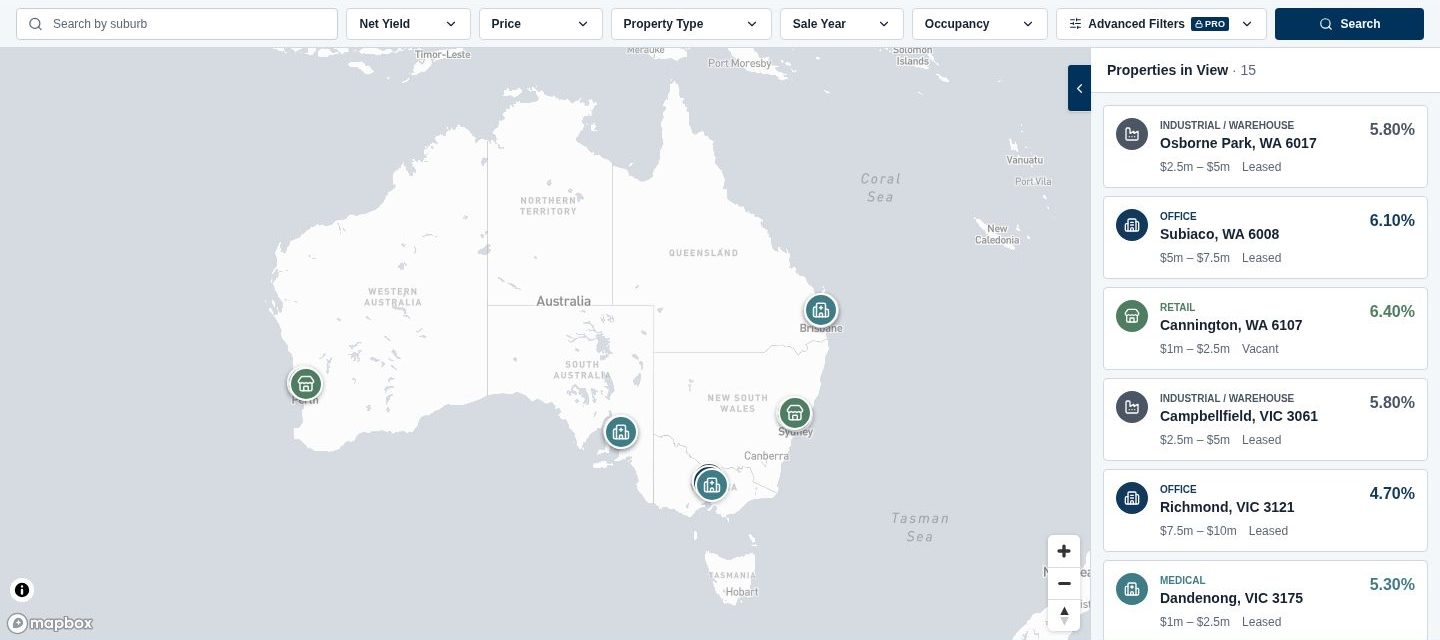
CapRates is being developed to allow users to filter commercial property transactions by yield, price, property type, sale year, occupancy and location, then review key transaction and lease metrics.
Be First to Access CapRates
Join the early access list and be notified when commercial property data becomes available on CapRates.